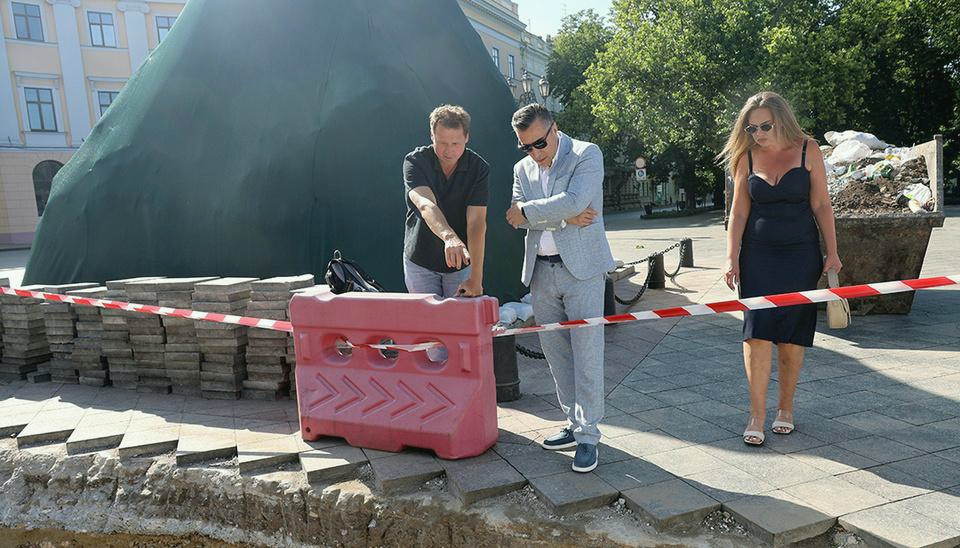
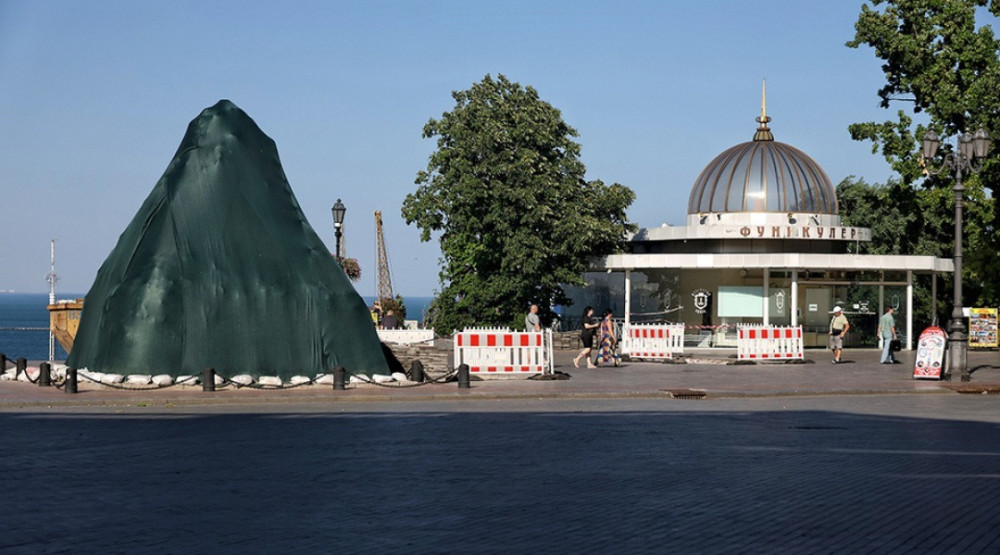
Archaeological excavations have resumed at Primorsky Boulevard in Odessa, near the Duke de Richelieu monument. The work is being conducted by students from the South Ukrainian National Pedagogical University named after Ushynsky and staff from the Institute of Archaeology of the National Academy of Sciences of Ukraine.
This was reported by a correspondent from Ukrinform.
According to the rector of the university, Andriy Krasnozhon, ground-penetrating radar studies conducted back in 2021 indicated an anomaly on Primorsky Boulevard not related to modern communications. Follow-up studies carried out in the spring of 2025 confirmed this anomaly.
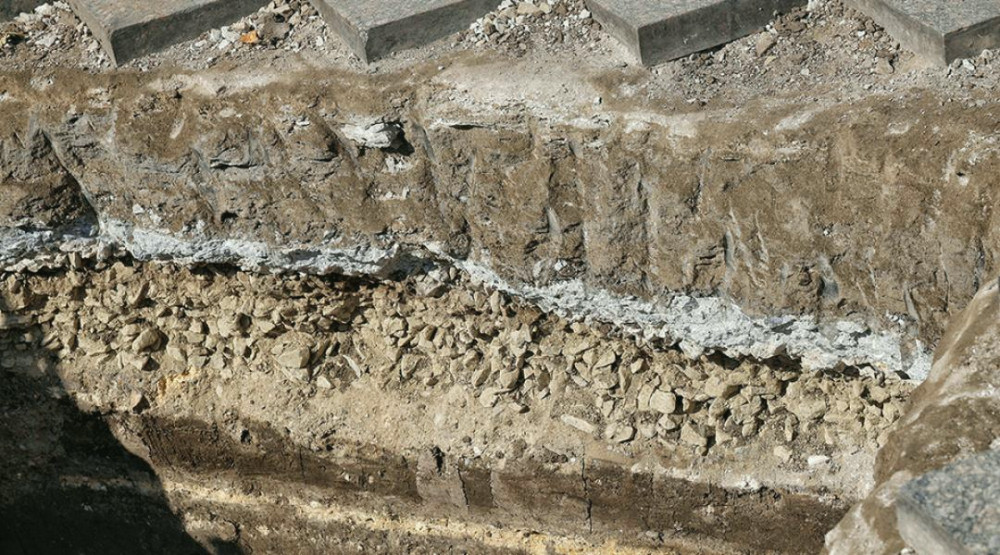
“We have discovered that beneath the Duke lies cultural layers over 2500 years old. These are remnants of the ancient Greek colony of the Histrian Harbor, established in the 6th century BC and lasting for about 300-400 years. We found fragments of amphorae that confirm the existence of layers dating back to the 5th century BC,” Krasnozhon explained.
During the excavation, the team uncovered several storage pits and numerous distinct fragments of plaster, indicating the presence of residential areas during the ancient Greek period.
No excavations had been conducted in this area previously.
“It appears that the ancient Greeks lived near the Vorontsov Palace. In the northern part of Primorsky Boulevard, we found no Greek layers, but they suddenly appear robustly near the Duke's monument. Most likely, there was a ravine that served as a natural barrier for the Greek settlement occupying the southern part of Primorsky Boulevard up to the Pushkin monument,” Krasnozhon said.
Archaeologists also discovered a unique fragment of red-gloss pottery from the Roman era, which is the first of its kind found at the site over decades of research on the “Primorsky Boulevard” object.
“It was previously believed that in antiquity, there was only a Greek settlement from the 5th to 3rd century BC where Odessa is now located. Now, for the first time, we are recording signs of possible human presence during the time of the Roman Empire,” the historian noted.
Additionally, researchers were surprised by the discovery of a significant amount of 14th-century material, including a prominent fragment of a bowl with geometric ornaments.
“This indicates that there was a trading post here. Imported goods could have only arrived by sea. It is likely that this was the Italian trading post of Ginestera. This finding also confirms that we need to reconsider how long Odessa has existed. Each shovel of dirt provides new dating,” Krasnozhon stated.
The excavation also revealed remnants of a civil structure made of heavy stone blocks.
“We know that a stone fortress of Khadjibey once stood around here. I can confidently say that these blocks were moved during the dismantling of the fortress. The stones weigh about 40-60 kg and have hewn edges. One resembles the top of a column turned upside down. This is material used for building fortifications. With this masonry, we also found red-gloss pottery. There has been much debate about where the fortress was located and who built it. In the context of these moved stones and the 14th-century pottery fragment, it offers a hint,” Krasnozhon said.
In a week, the team plans to begin work on a new excavation at Primorsky Boulevard.